South Africa has no public register of its data centres, and operators do not have to disclose how much power or water they use. The numbers below are the best estimates in the public record, with their limits stated.
Power today
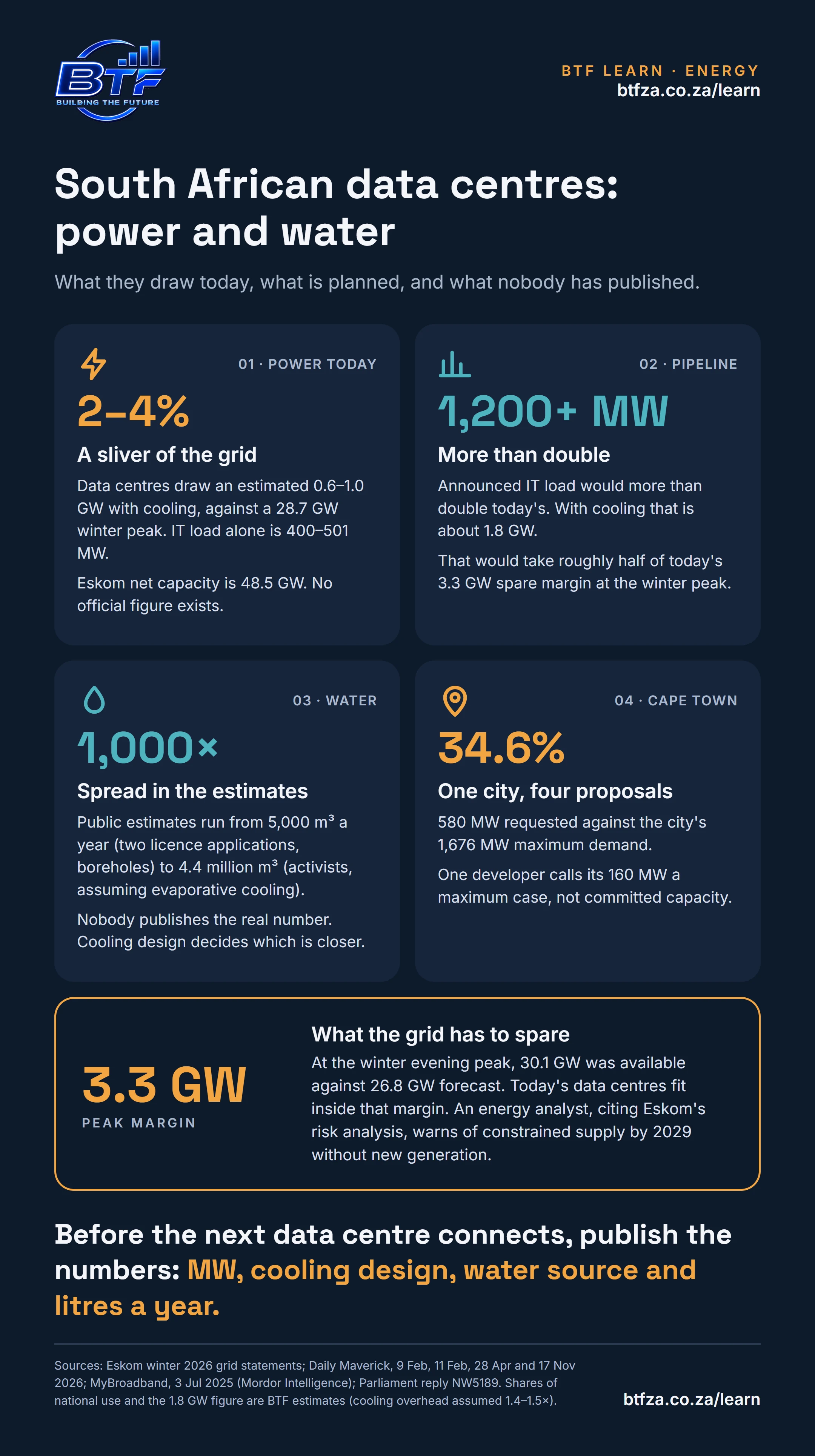
Industry estimates put South Africa’s data centre IT load at 400 to 501 MW. That is the load of the computers themselves, before cooling. Adding cooling, the draw is an estimated 0.6 to 1.0 GW.
Against the grid, in winter 2026:
| Value | |
|---|---|
| Eskom net generation capacity | 48.5 GW |
| Available at the evening peak | 30.1 GW |
| Forecast evening peak | 26.8 GW |
| Spare margin at the peak | about 3.3 GW |
| Actual peak demand (instantaneous) | 28.7 GW |
That puts data centres at roughly 2 to 4% of national electricity use and about 1 to 2% of Eskom’s net capacity. These shares are BTF estimates: they assume cooling adds 40 to 50% on top of the IT load, which no source states, and they use a published 2024 generation figure of about 215 TWh from a secondary source.
What is planned
Announced projects would take South Africa’s data centre IT load to 1,200 MW or more, more than double today’s. With cooling that is about 1.8 GW, roughly half of today’s 3.3 GW peak margin. The announcements do not give timelines and some of the figures do not add up: one operator’s own capacity target is lower than its current load plus its announced new capacity.
In Cape Town, four proposed data centres have requested 580 MW, which is 34.6% of the city’s 1,676 MW maximum demand. One developer describes its 160 MW share as a maximum case rather than committed capacity. The city has declined to publish what the existing data centres use, citing privacy law.
An energy analyst, citing Eskom’s own risk analysis, has warned that large new data centres could lead to constrained supply by 2029 unless new generation is added quickly.
Water: a thousand-fold spread
No one has published a national water figure. The public estimates:
| Estimate | Volume a year | Basis |
|---|---|---|
| Two licence applications (Western Cape and Johannesburg) | about 5,000 m³ | Raw groundwater from boreholes, for cooling |
| One operator’s own report | about 34,000 m³ | Self-reported, 2025 |
| Activist submission | over 4.4 million m³ | Hyperscale sites, assuming evaporative cooling |
The gap comes from the cooling design. Closed-loop and dry (air) cooling use very little water; evaporative cooling uses a lot. Some operators say their new Cape Town sites need no water for cooling the data halls. The Department of Water and Sanitation says it cannot report municipal water use by data centres, because municipalities supply it.
The engineer’s test
Before the next data centre connects, publish the numbers: MW, cooling design, water source and litres a year.
A data centre can be efficient per computer and still be a large new load on a constrained grid or a stressed water supply. Without those four numbers, nobody outside the project can judge which.